


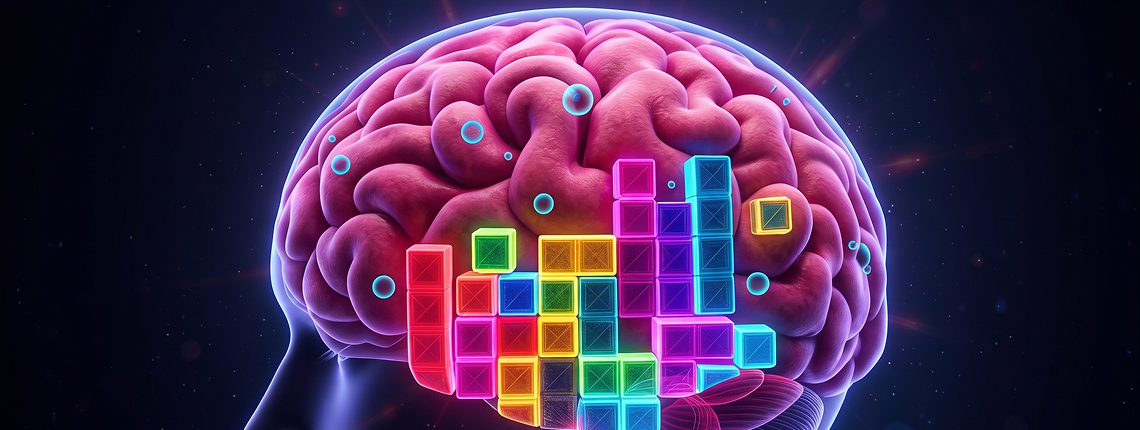
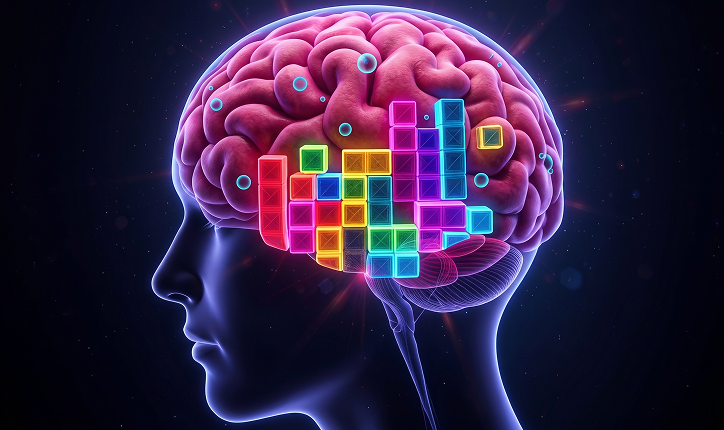
In Short: Cravings and late-night intrusive thoughts rely heavily on vivid mental imagery generated by your brain. Playing Tetris for just 3 to 10 minutes overloads your visual processing center, short-circuiting these mental images and significantly reducing craving intensity. 
You weren’t even thinking about food ten minutes ago, were you? Then, out of nowhere, your brain decides that a family-sized bar of chocolate is suddenly the most important thing on planet Earth.
You can already taste the sugar. You can imagine the texture, the smell, and that first perfect bite. 
Your brain has gone from casually existing to producing a full sensory commercial for something sitting in your kitchen. And unfortunately, your willpower didn’t come with a “Skip Ad” button. 
Before you start negotiating with yourself or staring blankly into the pantry, there is an unexpected, research-backed fix: open Tetris. Not a meditation app. Not a sleep story recorded in a rainy forest. Just the simple game of falling blocks.
While it sounds like unorthodox productivity advice, it is grounded in cognitive neuroscience and works within minutes.
A Craving Is More Than “I Want Chocolate”
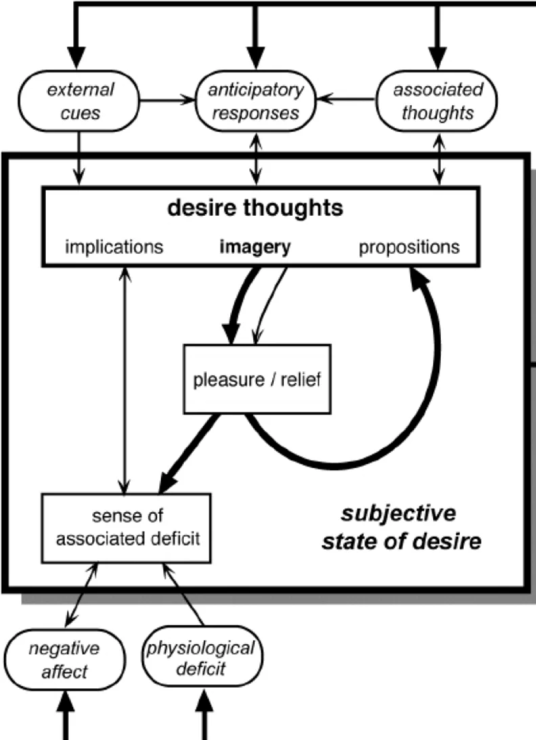
When you really want a particular food, it is not necessarily just a sentence running through your head. You might picture the chocolate melting, imagine the crunch of a biscuit, or mentally replay the exact taste of your favorite snack. 
This is part of the Elaborated Intrusion Theory of Desire, developed by researchers David Kavanagh, Jackie Andrade, and Jon May. According to the theory, an initial thought about something desirable can develop into detailed mental imagery.
Your Brain Has Limited Mental Bandwidth
Visualizing food takes cognitive resources. Tetris asks your brain to process shapes, positions, rotations, and movement at the same time.
Imagine your brain has limited RAM.
One process is rendering that extremely detailed chocolate commercial. Then you open Tetris and another demanding visual task starts running. The two activities will compete for some of the same mental resources – this is known as cognitive interference.
The Three-Minute Effect 
In a 2014 study, participants either played Tetris for three minutes or used a computer that was simply loading after being exposed to cues that could trigger an urge. Those who played Tetris reported lower craving intensity and less vivid mental imagery than the control group.
A follow-up study published in Addictive Behaviors tested the idea in everyday life. Participants tracked naturally occurring desires for a week, including food, caffeine, alcohol, nicotine and gaming. When a desire appeared, they played Tetris for three minutes. 
Reported urge intensity decreased by an average of 14 percentage points.
The results are interesting, but they come with an important limitation. Research suggests that a few minutes of an engaging visual and spatial task may temporarily make certain cravings less intense and vivid. They do not show that Tetris permanently eliminates addiction or eating disorders.
TRY IT YOURSELF: The 3-Step Anti-Craving Protocol
Next time you notice yourself becoming fixated on a particular food, pause before immediately acting on the impulse.
STEP 1: Spot the Hijack
The moment a vivid food commercial or an anxiety replay starts playing in your head. That’s your cue. Don’t fight it, don’t negotiate. Just catch it. 
STEP 2: Execute 3–10 Mins of Tetris (100% Focus)
Fire up Tetris on your phone or browser. Rule #1: Zero multitasking. No podcast in the background, no scrolling TikTok. Lock in completely. You need your brain’s entire visual GPU focused on stacking blocks.
STEP 3: Run a System Check
Game over. Stop and check your status: Is the craving still running at full resolution, or did the signal fade? 9 times out of 10, the loop is broken, and you’re back in control.
WE NEED YOUR BRAIN: Join Our Community Tetris Experiment 
Reading research is cool. Running our own data is better.
We’re building a community of proactive, high-performing minds who actually test life-hacks on themselves instead of blindly trusting internet claims. We want to run our own community study to see how well this Tetris protocol holds up in the wild. And we need you in it.
Sign-up takes literally 30 seconds. Join the group and let’s test real-time brain hacks together.
How to join:
- Click
 here to open the Sign-Up Form
 - Fill in 3 quick fields: Age, Gender, and your IG or Discord handle.
- We’ll slide into your DMs with the exact instructions and your experiment tracker when the study launches.
Disclaimer: This is an informal community-led experiment designed for self-optimization, personal curiosity, and fun. It is not a clinical medical trial and is not intended to treat eating disorders, clinical anxiety, or substance addiction. Respect your health and use common sense.
Loved this deep dive? We break down real science, cut out the fluff, and build actionable protocols for healthy, high-performing minds.
Drop your email below to subscribe. Get our next article, science breakdown, and community experiment delivered straight to your inbox. 



Comments
dávám like
Leave a Comment